
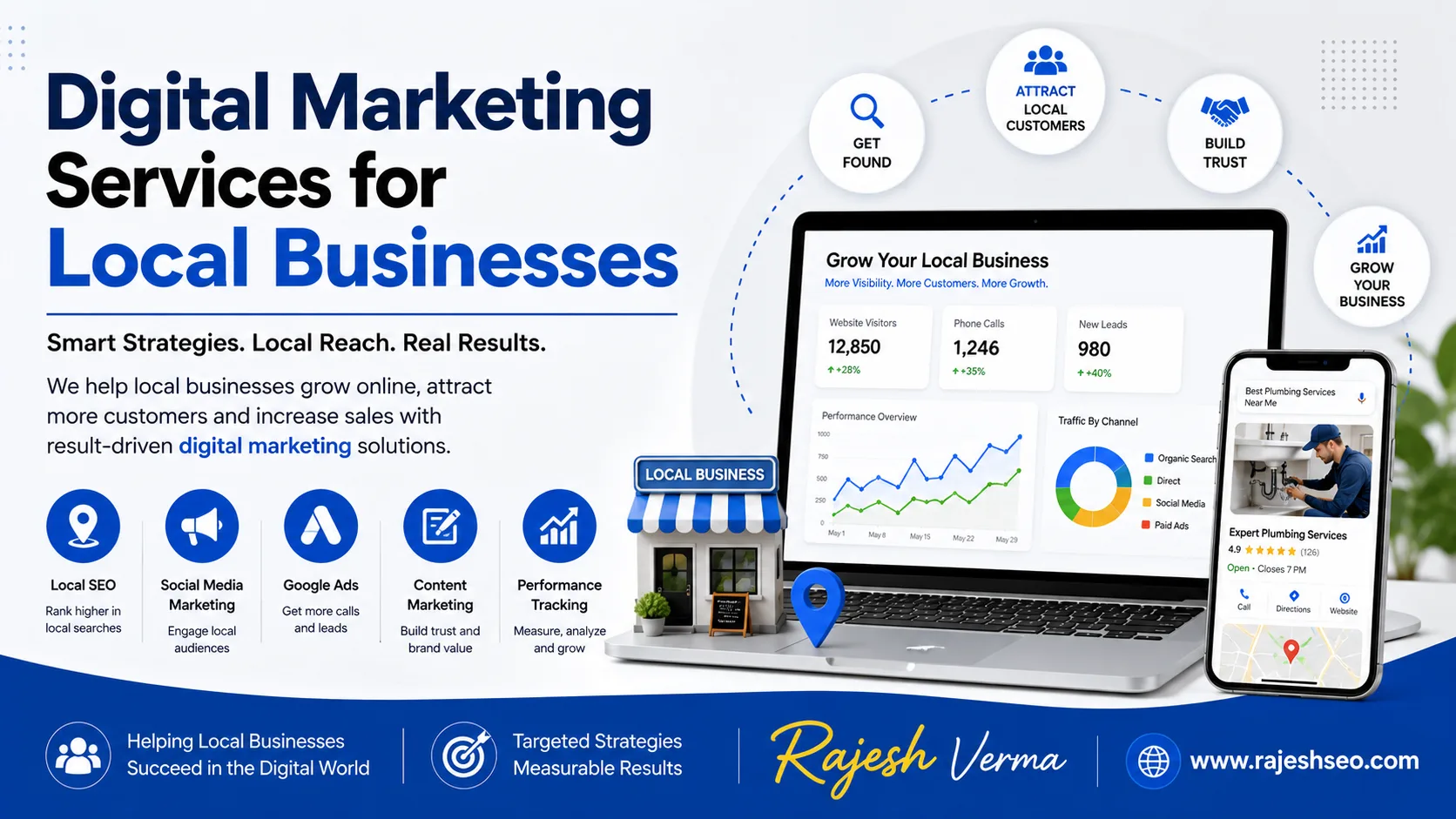
Run a local business long enough, and you'll notice something odd: word-of-mouth alone doesn't cut it anymore, even in a small town where everyone supposedly knows everyone. People still search online before they call, before they visit, before they decide who gets their money — even for something as simple as picking a nearby restaurant or a plumber. If your business isn't visible in that search, you're losing customers to competitors who are, sometimes ones with a worse product but a better online presence.
That's really what digital marketing for local businesses comes down to: making sure that when someone nearby is looking for what you offer, you're the one they find first. It sounds simple, but there's a lot happening behind the scenes to make that actually work.
Why Local Businesses Can't Skip Digital Marketing Anymore
A few years ago, it was still possible for a local business to get by mostly on foot traffic, referrals, and maybe a listing in the phone book — remember those? That world is basically gone. Most people now start their search for a local business on their phone, usually with a quick search like "best coffee shop near me" or "24 hour locksmith [city name]."
What's interesting is that these searches often lead to a decision within minutes. Someone doesn't scroll through ten pages of results comparing every option in detail — they check the top few results, glance at reviews, maybe look at photos, and make a call. If your business isn't showing up in that critical window, it doesn't matter how good your service actually is. You never even entered the conversation.
Digital marketing exists to make sure you're part of that conversation, consistently, not just occasionally when the stars align.
The Core Pieces of Local Digital Marketing
Digital marketing for local businesses covers a fair amount of ground, and it works best when these pieces are connected rather than treated as separate, disconnected efforts.
Local SEO
This is usually the foundation, and for good reason. Local SEO focuses on making sure your business shows up when people search for what you offer combined with a location — either explicitly, like "electrician in Jaipur," or implicitly, when Google detects someone's searching nearby and shows local results automatically.
A big part of this revolves around your Google Business Profile. Keeping it accurate, filled out completely, and regularly updated with photos, posts, and correct hours makes a bigger difference than most business owners realize. Reviews matter enormously here too — not just having them, but responding to them, since that activity signals to both customers and search engines that your business is active and engaged.
Local SEO also includes making sure your business information is consistent everywhere it appears online — your website, directories, social profiles. Inconsistent addresses or phone numbers across different platforms can quietly hurt your visibility, even though it seems like a small detail.
Website Optimization
Your website is often the first real impression someone gets of your business beyond a search snippet, and for local businesses, it needs to do a few things well: load quickly, work smoothly on mobile devices, and make it obvious what you offer and how to contact you. A confusing or outdated website can undo all the work done to get someone there in the first place.
For local businesses specifically, this also means having clear location information, service area details, and pages that speak directly to the specific services you offer in your specific area, rather than generic, vague descriptions that could apply to any business anywhere.
Social Media Presence
Social media plays a different role for local businesses than it does for larger national brands. It's less about viral reach and more about building familiarity and trust within your immediate community. Regular posts showing your work, your team, customer interactions, or behind-the-scenes moments help people feel like they know your business before they ever walk through the door.
It also gives your business a place to engage directly with customers, answer questions, and stay visible in the feeds of people who live and work nearby — which matters more for a local business than trying to reach people across the country who will never actually become customers.
Paid Advertising
While organic visibility through SEO takes time to build, paid advertising — particularly Google Ads and social media ads — offers a faster way to get in front of local customers. For local businesses, this often means geographically targeted campaigns that only show ads to people within a specific radius, ensuring budget isn't wasted on clicks from people who could never realistically become customers.
Paid ads work particularly well for local businesses with time-sensitive promotions, seasonal services, or a need to fill appointment slots quickly, since results can start showing up almost immediately rather than requiring months of organic growth.
Online Reviews and Reputation Management
For local businesses, reviews function almost like digital word-of-mouth. Most people check reviews before deciding where to spend their money locally, and a business with a handful of old, unanswered reviews looks far less trustworthy than one with recent, thoughtful responses to both positive and negative feedback.
Actively managing this — encouraging satisfied customers to leave reviews, responding professionally to criticism, and keeping an eye on what's being said about your business across different platforms — is a genuine part of digital marketing, even though it doesn't always get discussed alongside SEO and ads.
Email and Direct Communication
Not every local business needs a complex email marketing strategy, but for many, staying in touch with existing customers through email or text updates helps drive repeat business. A simple monthly update, a seasonal promotion, or a reminder about a service due for renewal can bring customers back without requiring them to search for you again — because you're already in their inbox.
Why an Integrated Approach Works Better Than Isolated Efforts
One of the most common mistakes I see local businesses make is treating these pieces as separate, unrelated tasks — running a few social media posts here, trying some Google Ads there, without any of it connecting to a bigger strategy. When these pieces work independently rather than together, results tend to be inconsistent and hard to measure.
When they're connected, though, each piece reinforces the others. Someone might see a social media post, later encounter your business again through a search, check your Google reviews, visit your website, and convert. Each touchpoint builds on the last, and businesses that plan their digital marketing holistically tend to see stronger, more predictable results than those running scattered, disconnected campaigns.
This is also where consistency plays a bigger role than people expect. A business that posts occasionally, updates its Google profile once a year, and runs ads sporadically will always underperform compared to one that stays consistently active across these channels, even if the individual efforts are relatively modest.
What Results Typically Look Like
Local digital marketing tends to move a bit faster than broader, national strategies, mainly because the competition pool is smaller and more geographically limited. That said, it still isn't instant. Paid advertising can generate leads within days, but SEO and reputation-building generally take a few months to show meaningful movement.
In the earlier stages, a lot of the focus is on fixing gaps — an incomplete Google profile, a slow website, inconsistent business information across the web. Once those foundational issues are addressed, visibility tends to improve steadily, and businesses often start noticing more calls, more direction requests, and more foot traffic tied directly back to their online presence.
Over time, as reviews accumulate, content builds up, and consistency continues, local businesses often reach a point where they're the default choice in their area for their particular service — not because they're spending the most, but because they've built a stronger, more visible presence than competitors who treated digital marketing as an afterthought.
Common Pitfalls Local Businesses Should Avoid
A handful of mistakes show up repeatedly with local businesses trying to manage this on their own or hiring the wrong help.
Neglecting the Google Business Profile. This is often the single highest-impact piece of local marketing, and yet it's frequently left incomplete or outdated.
Ignoring reviews. Both good and bad reviews deserve a response. Silence, especially on negative reviews, tends to look worse than the review itself.
Inconsistent branding and information. Different addresses, phone numbers, or business names across platforms confuse both customers and search engines.
Focusing only on ads without building organic presence. Paid ads can dry up the moment budget stops. Organic SEO and reputation continue working even during slower months.
Trying to appeal to everyone everywhere. Local businesses do best when their marketing clearly targets their actual service area, rather than trying to compete broadly against businesses in other cities entirely.
Bringing It All Together
Digital marketing for local businesses isn't about doing everything at once or chasing every trend that comes along. It's about building a consistent, connected presence across the places your potential customers are already looking — search results, social media, reviews, and your own website — so that when someone nearby needs what you offer, your business is the obvious answer.
For local businesses trying to grow in a competitive area, this kind of steady, well-rounded digital presence tends to matter far more than any single flashy tactic, and it's usually the businesses willing to stay consistent with it that end up seeing the biggest, most lasting results.