
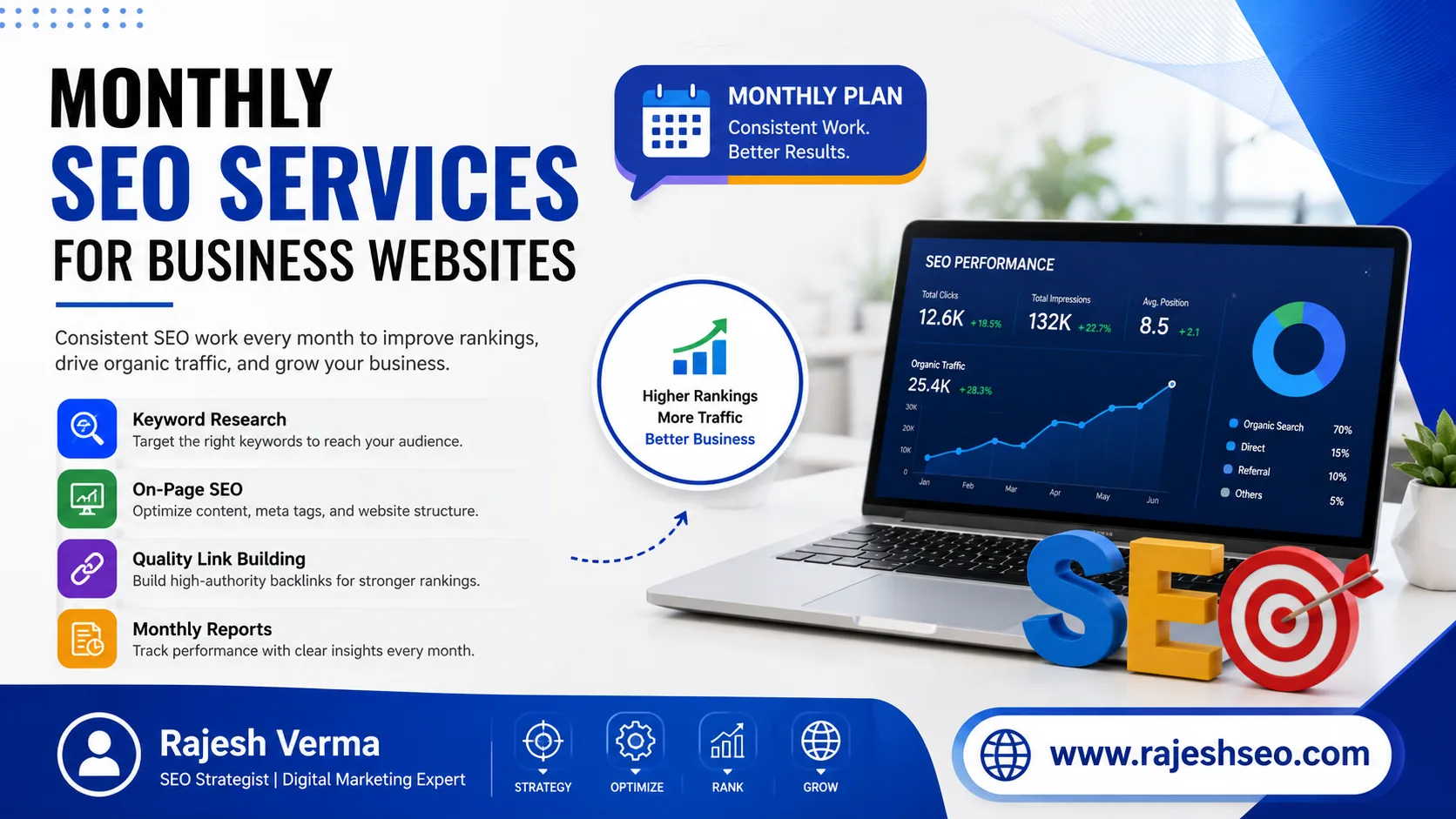
If you've ever launched a website and then just... waited for customers to show up, you already know the hard truth: nobody's coming. Not because your business isn't good, and not because your website looks bad. It's because Google doesn't know you exist yet, and even if it does, it hasn't decided you're worth showing to anyone. That's where monthly SEO services come in, and honestly, it's one of those things business owners either swear by or dismiss entirely — usually depending on whether they've worked with someone who actually knew what they were doing.
I've spent years helping business websites climb search rankings, and I want to walk you through what monthly SEO really looks like, why a one-time fix almost never works, and how to think about it if you're deciding whether it's worth the investment.
Why SEO Isn't a "Set It and Forget It" Job
A lot of business owners still think of SEO the way they think of building a website: pay someone once, get it done, move on. I get why — that's how most other services work. You hire a contractor to renovate your kitchen, and once it's finished, it's finished. But search engines don't work that way, and neither does the competition sitting right behind you in the rankings.
Here's the thing nobody tells you upfront: Google's algorithm changes constantly. Not once a year — constantly. Some updates are minor tweaks nobody notices. Others can shuffle rankings overnight and send a page that used to sit comfortably on page one straight down to page four. If your SEO strategy was built around last year's rules, you're already playing catch-up.
On top of that, your competitors aren't standing still either. While you're reading this, somewhere another business in your industry is publishing new content, building backlinks, or fixing technical issues on their site that are quietly pushing them ahead of you. SEO is relative — it's not enough to be good, you have to be better than whoever else is trying to rank for the same searches. That's a moving target, and it needs ongoing attention, not a one-time push.
What Actually Happens in a Monthly SEO Package
People are often surprised by how much work goes into SEO on a month-to-month basis. It's not just "adding some keywords" — that idea is honestly a decade out of date. A proper monthly SEO service usually covers several moving parts that all work together.
Technical Health Checks
Every month, a good SEO process should include checking the bones of your website. This means making sure pages load quickly, there are no broken links dragging down user experience, your site is mobile-friendly (which, frankly, is non-negotiable at this point), and there are no indexing errors quietly keeping pages out of Google's search results. Technical issues are sneaky — they can appear after a routine software update or a new plugin, and if nobody's watching, they can sit there for months costing you traffic without you ever noticing.
Content Strategy and Publishing
Search engines reward websites that stay active and genuinely useful. That doesn't mean cranking out generic blog posts just to hit a quota — it means figuring out what your potential customers are actually searching for and creating content that answers those questions better than what's currently ranking. This could be blog articles, service page updates, FAQs, or even refreshing older content that's started to lose steam. Content is often the biggest piece of ongoing SEO work, and it's also the piece that tends to compound over time — an article you publish today might still be bringing in traffic two or three years from now.
Keyword Research That Evolves
The keywords that mattered to your business last year might not be the ones mattering this year. Search trends shift, new competitors enter the picture, and customer language changes. Monthly SEO involves regularly revisiting keyword opportunities, seeing what's gaining traction, and adjusting strategy so you're not chasing terms nobody's searching for anymore.
Link Building and Authority
Backlinks — other websites linking to yours — remain one of the strongest trust signals search engines use. Earning these links takes consistent outreach, relationship-building, and sometimes just being patient enough to get noticed by the right sites. This isn't something that happens in a single burst; it's a slow accumulation of credibility that builds your site's authority over months and years.
Local SEO Maintenance
For most small and mid-sized businesses, local visibility matters just as much as national rankings, sometimes more. This means keeping your Google Business Profile updated, managing reviews, making sure your business information is consistent across directories, and optimizing for "near me" style searches. Local SEO is easy to neglect because it feels like a smaller task, but it's often where businesses see the fastest, most tangible returns.
Analytics and Reporting
None of this matters if nobody's checking whether it's working. A solid monthly SEO process includes tracking rankings, organic traffic, conversions, and user behavior, then using that data to adjust the strategy going forward. SEO isn't a guessing game — or at least it shouldn't be. The businesses that see the best long-term results are the ones where strategy gets refined based on actual performance, not just gut feeling.
Why Businesses Choose Monthly Plans Over One-Time Projects
There's a reason ongoing SEO has become the standard rather than the exception. A few reasons, actually.
Rankings aren't permanent. Even if you reach page one for a valuable keyword, that position isn't locked in. Competitors will try to take it from you, algorithm updates will test it, and if your content starts feeling outdated, Google will notice before you do. Ongoing SEO exists to defend the ground you've already won, not just to gain new ground.
SEO compounds. This is probably the most underrated part of the whole process. The work you do in month one lays groundwork for month three. The content published in month three might not show results until month six, but by month twelve, all those pieces start reinforcing each other — internal links connecting related articles, authority building page by page, and search engines gaining more confidence in your site as a whole. Businesses that stop SEO too early usually pull the plug right before it was about to pay off.
Markets change. New competitors show up. Customer needs shift. A product you barely mentioned two years ago might now be your biggest revenue driver, and your website content needs to reflect that. Ongoing SEO keeps your online presence aligned with where your business actually is, not where it used to be.
Consistency builds trust with search engines. Google tends to favor websites that show steady, genuine growth and activity over sites that get a sudden burst of optimization and then go quiet. A monthly approach signals to search engines — and to your actual visitors — that your business is active, current, and worth showing up for.
What Results Actually Look Like Over Time
If there's one thing I try to be upfront about with every business owner I talk to, it's this: SEO is not fast. Anyone promising overnight rankings is either exaggerating or setting you up for a strategy that won't last. Real, sustainable SEO tends to follow a rough pattern.
In the first couple of months, most of the work is foundational — fixing technical issues, filling content gaps, cleaning up anything that's actively holding the site back. You might not see dramatic ranking jumps yet, but this groundwork is what everything else depends on.
Somewhere around the three-to-six-month mark, movement usually starts becoming visible. Keywords begin climbing, organic traffic ticks upward, and pages that didn't exist before start pulling in visitors. This is often when business owners start feeling like the investment is paying off.
Past the six-month point, and especially heading into the first year, momentum tends to build more noticeably. Rankings stabilize higher, traffic becomes more predictable, and the site starts generating leads or sales without nearly as much manual effort. This is the phase where SEO starts feeling less like an expense and more like an asset.
It's worth saying clearly: every industry and every website is different. A local service business with light competition might see faster results than a company trying to rank nationally in a crowded market. But the general shape — slow build, then compounding growth — holds true across most industries.
Common Mistakes Businesses Make With SEO
I've seen a lot of businesses get frustrated with SEO, and almost every time, it traces back to one of a few recurring issues.
Expecting instant results. SEO is a long game. Businesses that judge success after four or six weeks are almost always going to be disappointed, not because the strategy failed, but because it hadn't been given enough time to work.
Treating content as filler. Publishing thin, generic articles just to "have content" rarely moves the needle. Search engines — and readers — can tell when something was written to check a box rather than to genuinely help someone.
Ignoring technical issues. You can publish the best content in the world, but if your site loads slowly or has structural problems, none of that content will get the visibility it deserves.
Going quiet after early progress. This is probably the most common one. A business sees good early results, assumes the work is done, and pauses their SEO efforts. Rankings that took months to earn can slip within weeks once the effort stops, especially in competitive industries.
Chasing keywords with no real intent behind them. Ranking for a high-volume keyword sounds great until you realize the people searching it have no interest in buying what you sell. Good SEO focuses on relevance and intent, not just search volume.
Choosing the Right Monthly SEO Partner
If you're evaluating SEO services for your business, a few things are worth paying attention to. Transparency matters — you should understand what's actually being done each month, not just receive a vague report with numbers that don't mean much on their own. Communication matters too; SEO works best when there's an ongoing conversation about what's working, what isn't, and how the strategy is adjusting.
Be cautious of anyone guaranteeing specific rankings or promising results within an unrealistically short window. Search engines don't work on guarantees, and any strategy that leans on shortcuts or manipulative tactics can end up doing more harm than good, sometimes resulting in penalties that take far longer to recover from than the short-term gains were worth.
What you want is a strategy tailored to your specific business, your specific audience, and your specific goals — not a generic template applied to every client regardless of industry.
Monthly SEO isn't glamorous. It's not a quick win, and it doesn't come with the instant gratification of, say, running a paid ad campaign that starts sending clicks the same day. But that slow, steady, unglamorous work is exactly why it's so effective. It builds something that paid ads can't: a website that keeps earning visibility and trust long after the initial effort was made.
For business owners genuinely serious about growing an online presence that lasts, ongoing SEO isn't really optional — it's the difference between a website that quietly sits there and one that actively brings in customers month after month, year after year.
If you're weighing whether monthly SEO makes sense for your business, the honest answer is: it depends on your goals, your market, and how competitive your industry is online. But for most businesses trying to build sustainable, long-term visibility, it remains one of the smartest investments you can make.