If you run a business website and you're still wondering why your competitors show up on the first page of Google while you're stuck on page three, the answer usually comes down to one thing: on-page SEO. Not backlinks, not some secret algorithm trick, just the basics done properly on your own site.
I'm Rajesh Verma, and I've spent years helping business owners across India and abroad fix exactly this problem. Most websites I audit for the first time have the same issues — thin content, messy headings, slow loading pages, and zero internal linking strategy. None of these problems are complicated to fix. They just need someone who actually understands how Google reads a page, not someone copy-pasting a checklist from a random blog.
This guide covers everything a business owner should know about on-page SEO services, why they matter more than people think, and what a proper service should actually include.
What Is On-Page SEO and Why Business Websites Need It
On-page SEO refers to everything you optimize directly on your website to help it rank higher — your content, your HTML tags, your images, your site structure, and how easily both users and search engines can move through your pages. It's different from off-page SEO (backlinks, social signals, brand mentions) because you have full control over it. Nobody else needs to link to you or mention you for on-page SEO to work.
Here's the part most business owners miss: you can have the best product or service in your city, but if Google can't understand what your page is about, it simply won't show it to the people searching for you. Search engines don't "see" a website the way a human does. They crawl code, read text, check load speed, and try to match your page against thousands of ranking signals. On-page SEO is how you speak Google's language while still writing for real people.
For a business website specifically — whether it's a local shop, a service provider, or an e-commerce store — on-page SEO directly affects three things: how fast you get found, how much traffic actually converts into leads, and how long you stay ranked once you get there. Paid ads stop the moment you stop paying. Good on-page SEO keeps working long after the work is done.
On-Page SEO Services for Business Websites: What's Actually Included
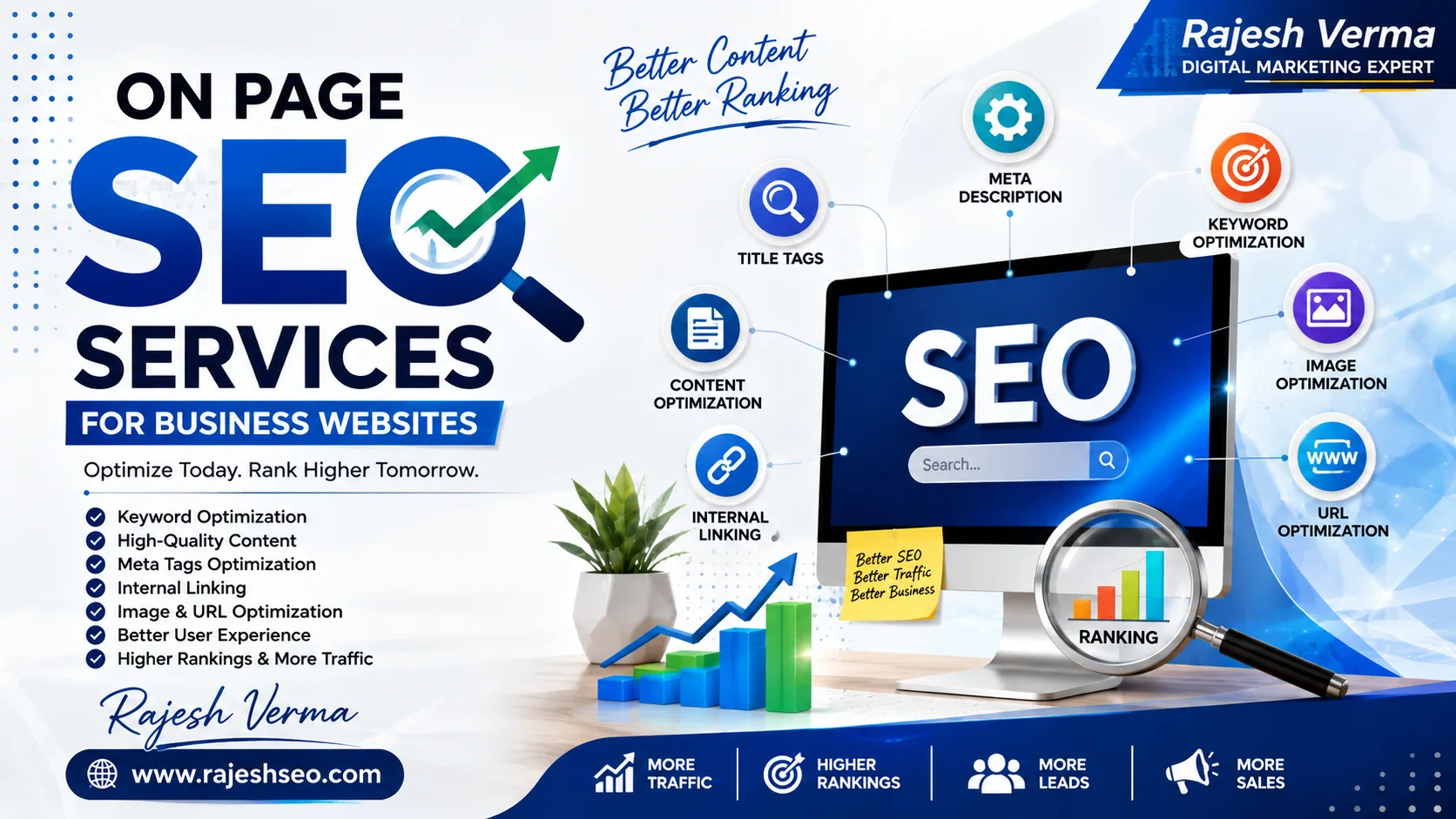
A lot of agencies throw around the term "on-page SEO service" without explaining what it actually covers. Here's what a proper service should include, based on what I run for every client:
- Website audit – checking existing pages for duplicate content, broken links, missing tags, and crawl errors
- Keyword mapping – assigning the right target keywords to the right pages instead of stuffing everything onto the homepage
- Content optimization – rewriting or restructuring existing content so it answers search intent properly
- Title tag and meta description writing – crafted to improve click-through rate, not just stuffed with keywords
- Header tag structure (H1, H2, H3) – organizing content so both users and Google can scan it easily
- Image optimization – compressing files and writing proper alt text
- Internal linking – connecting related pages so visitors and crawlers move naturally through the site
- URL structure cleanup – short, readable, keyword-relevant URLs
- Schema markup – helping search engines understand exactly what your page represents
- Core Web Vitals fixes – improving load speed, layout stability, and interactivity
Every one of these pieces plays a role. Skip even one, and you leave ranking potential on the table. This is exactly why a piecemeal approach — where someone just "adds a few keywords" — rarely moves the needle. On-page SEO works as a system, not a single task.
Keyword Research and Content Optimization for Business Websites
Keyword research is where most on-page SEO campaigns either succeed or quietly fail before they even begin. Business owners often want to rank for broad terms like "best shoes" or "digital marketing agency," not realizing how competitive and vague those searches are. What actually brings in customers is a mix of your core service keywords plus long-tail variations that match how real people search — things like "affordable digital marketing agency for small business in Jaipur" instead of just "digital marketing agency."
Once we know what your ideal customer is typing into Google, the next step is matching that intent with your content. This means understanding whether someone searching a term wants information, wants to compare options, or is ready to buy. A page built for someone researching "what is on-page SEO" needs a completely different structure and tone than a page built for someone searching "hire on-page SEO expert."
Content optimization isn't about hitting a keyword density percentage — that outdated approach can actually hurt you now. It's about covering a topic thoroughly enough that Google recognizes your page as the most useful answer available. That means addressing related questions, using natural variations of your target keyword, and structuring the page so someone can actually find what they came for within seconds of landing.
Technical On-Page SEO: Site Speed, Mobile-Friendliness, and Core Web Vitals
Here's something that surprises a lot of clients: you can have perfectly written content and still rank poorly because of technical issues that have nothing to do with your writing. Google has made it clear that page experience is a ranking factor, and that includes how fast your site loads, how stable it feels while loading, and how well it performs on mobile devices.
Core Web Vitals measure three specific things — how quickly the main content loads, how quickly the page responds to a click or tap, and whether elements jump around while the page is still loading (that annoying moment when you go to click a button and an ad loads in above it, shifting everything down). Sites that fail these metrics tend to get pushed lower in rankings, even with great content.
Mobile-friendliness deserves its own mention because Google now uses mobile-first indexing, meaning it primarily looks at the mobile version of your site to decide how to rank you — not the desktop version. If your business site isn't built to perform well on a phone screen, you're already starting at a disadvantage regardless of how good your content is.
Fixing these technical issues usually involves compressing images properly, cleaning up unnecessary code, using browser caching, and sometimes just switching to better hosting. It's not glamorous work, but it's often the single biggest factor holding an otherwise well-optimized site back from ranking where it should.
Meta Tags, Title Tags, and Header Optimization That Actually Ranks
Title tags and meta descriptions are the first thing a potential customer sees on the search results page, before they even click through to your site. A weak or generic title tag — something like "Home | ABC Company" — wastes prime real estate that could be pulling in clicks. A well-written title tag includes your primary keyword naturally, communicates value, and fits within Google's display limits so it doesn't get cut off.
Meta descriptions don't directly boost rankings the way title tags can, but they heavily influence click-through rate, which does send positive signals to Google over time. A description that clearly tells someone what they'll get by clicking — without sounding like a sales pitch — will consistently outperform one that's vague or overstuffed with keywords.
Header tags (H1, H2, H3) matter for a different reason: structure. Your H1 should clearly state what the page is about, and it should appear only once per page. Your H2s and H3s should break the content into logical sections that make sense to a human skimming the page, while also giving search engines a clear outline of what topics you're covering. When headers are used properly, they improve readability, reduce bounce rate, and make it far easier for Google to understand the hierarchy of information on your page.
Internal Linking and User Experience Strategies for Higher Rankings
Internal linking is one of the most underused tools in on-page SEO, mostly because it doesn't feel as exciting as writing new content or chasing backlinks. But connecting your pages properly does two important things: it helps visitors discover more of what you offer, and it helps search engines understand which pages on your site matter most.
Think of your website as a small city. If every road leads back to the homepage and nowhere else, visitors — and search engine crawlers — struggle to explore deeper pages. But if your blog posts link to relevant service pages, and your service pages link to related case studies or FAQs, you create pathways that keep people on your site longer and help Google index your content more efficiently.
User experience ties directly into this. A visitor who lands on your page and immediately feels lost — cluttered layout, walls of text with no breaks, confusing navigation — will leave within seconds. That bounce sends a signal to Google that your page didn't satisfy the search. On the other hand, a clean layout, clear calls to action, and a logical flow from one section to the next keeps people engaged, which supports better rankings over time. Good on-page SEO and good user experience aren't separate goals; they're the same goal approached from two angles.
Why Businesses Trust Rajesh Verma for On-Page SEO in India
I won't pretend there's some magic formula that only I know. On-page SEO works because it follows how search engines are actually built, and anyone willing to put in the work can learn the fundamentals. What sets my service apart isn't a secret — it's consistency, transparency, and actually treating every client's website like it's my own business on the line.
I've worked with business owners who came to me after spending money with agencies that handed over generic reports nobody could understand, or worse, agencies that used the same templated strategy for every client regardless of industry. That approach doesn't work, because a local dental clinic and a B2B software company need completely different keyword strategies, content depth, and page structures.
When you work with me, you're not getting outsourced work passed through three different hands. You're getting a strategy built around your specific business, your specific competitors, and your specific customers — backed by real reporting so you can see exactly what's improving and why. That's the standard I hold every project to, and it's why clients tend to stick around long after their first campaign wraps up.
If your business website deserves to be found by the people actually searching for what you offer, on-page SEO isn't optional anymore — it's the foundation everything else builds on.
Ready to Get Your Business Website Ranking Where It Belongs?
If you've read this far, you already understand that on-page SEO isn't a one-time fix — it's an ongoing investment in how your business gets discovered online. The good news is you don't have to figure it all out yourself. Whether your site needs a full technical overhaul or just sharper content and better structure, getting it right from someone who treats your growth seriously makes all the difference.
Reach out, share your website, and let's talk about what's actually holding your rankings back — and how to fix it properly.